Narrative Point of View for Architects
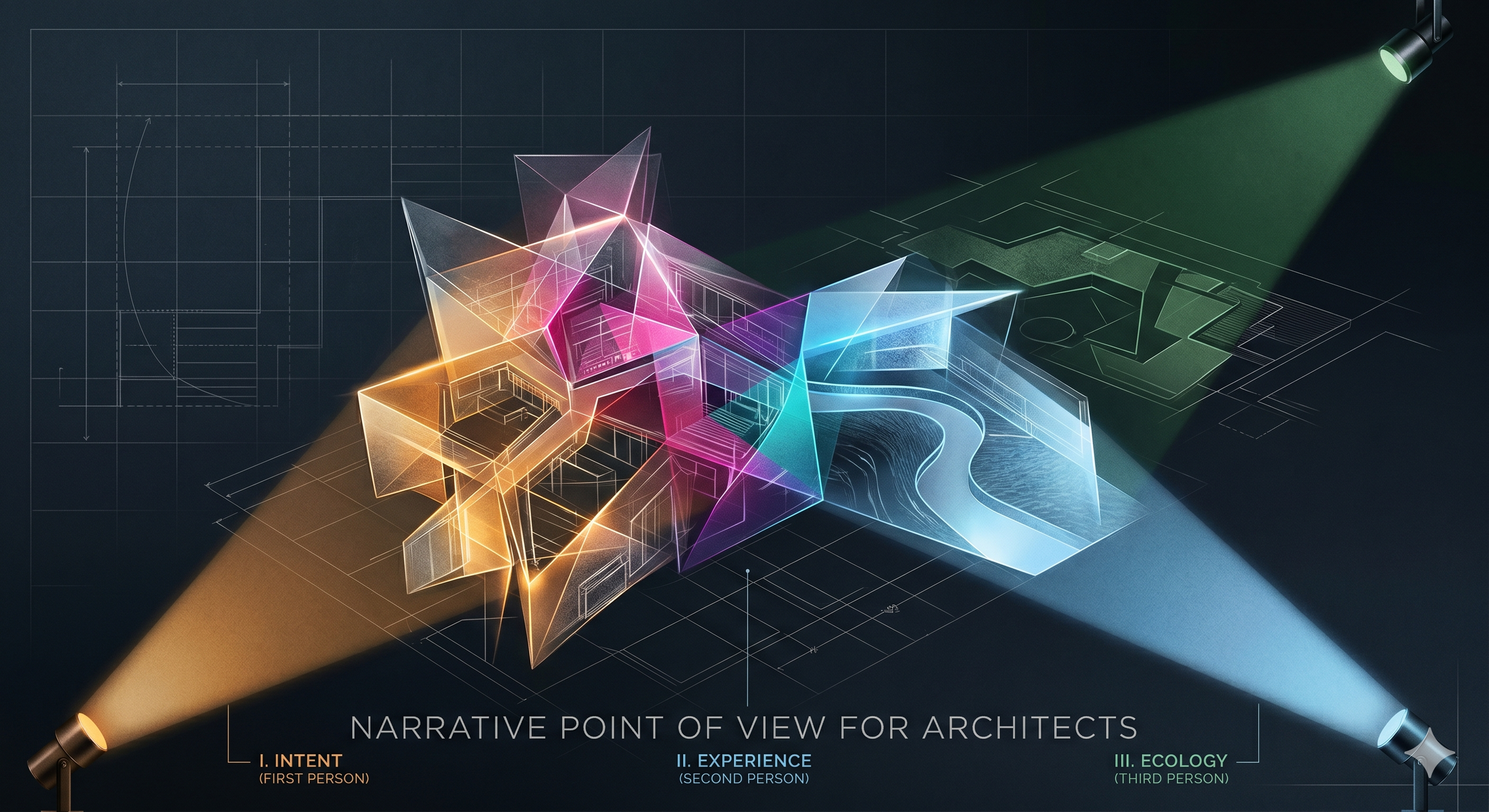
Generated by Google Gemini.
Architecture is often described through space, material, and form—but it’s equally a discipline of perspective or, in literary terms, “point of view.” Both visually and in narrative, who is speaking, and from what perspective? The point of view a writer adopts determines whether a building is perceived as a static object, a functional tool, or a living social organism. Selecting the right point of view (POV) for your story—or the story of a project—can make the difference between a reader engaging with your writing or, frankly, skimming through it.
First Person: Intent and Agency
Writing in the first person—the singular “I” or the collective “we”—places the reader inside the act of making. When the architect speaks, the building is rendered as a series of decisions under pressure. Constraints, ambitions, and compromises move to the foreground.
However, a truly original first-person account goes beyond the "ego" of the designer—in fact it’s best to leave the ego behind. “I” should be a window, not a mirror, giving agency to the experience of making, deciding, and seeking a certain outcome. In first person, we understand the wants of the first person voice and the challenges they face.
Another mode for first person collective—the "we"—includes the entire project team and the stone itself. The narrative becomes a record of verbs of force: how the steel resisted a curve, or how the glass demanded a specific solar orientation. It frames the structure not as a finished masterpiece, but as a temporary truce between a vision and the laws of physics.
Second Person: Sensory Choreography
The second person—“you”—shifts the building from a concept into an encounter. While often used for simple guides and instructional writing, its most powerful application is in describing the choreography of experience.
In this mode, architecture is an interface. The writer does not simply describe a hallway; they describe the shift in acoustics as you move from concrete to wood, or the way the light pulls you toward a specific window. To avoid the trap of scripting a universal experience, this POV should focus on sensory evidence: the temperature of a handrail, the weight of a door, the warmth of natural light, or the way a space compresses or releases the body. It treats the occupant not as a passive observer, but as the protagonist who completes the design.
Instead of telling the reader how they should feel, the second person provides the evidence that allows them to feel it for themselves.
Third Person: The Social and Temporal Ecology
Third-person writing introduces distance, but also breadth. It situates the building among its stakeholders—clients, neighbors, and critics—and among forces larger than any one individual: economics, climate, and culture. It’s the lens through which we navigate the built environment’s political and social friction, acknowledging that a project is often a hard-won consensus between conflicting public and private interests.
To elevate this perspective, we must look at the "unintended life" of the project. I often ask writers to think about their work after the architect has left the scene. This is the "fly-on-the-wall" point of view that observes how skateboarders reclaim a public plaza or how a facade weathers over decades. It considers a building’s temporal ecology: what was there before, and what will remain when the building’s functions inevitably change? Third person perspective can hold competing truths in tension and acknowledge that a building’s public face is a constant negotiation between regulation, occupation, and expression.
Conclusion: The Deliberate Position
These perspectives are not mutually exclusive; they are lenses to be swapped as the narrative requires. A piece may begin in the first person to ground the reader in the "why," move into the second to animate the "how," and widen into the third to critique the "result." Always, though, cue the reader that you have changed perspectives. Nothing frustrates a reader more than a story that moves from first to third person POV without warning.
To write about architecture is to choose a position in relation to it. The task is not to find a "correct" POV, but to recognize that every shift in perspective constructs a different building experience in the reader’s mind.
If you are interested in creating great stories about architecture, architects, architectural practice, and your projects or if you’re planning to pursue Fellowship in the AIA College of Fellows, please check out my books at https://www.architectactionresult.com/shop or through your favorite e-bookseller.