Fellowship, Part 4: Quantifying Your Influence
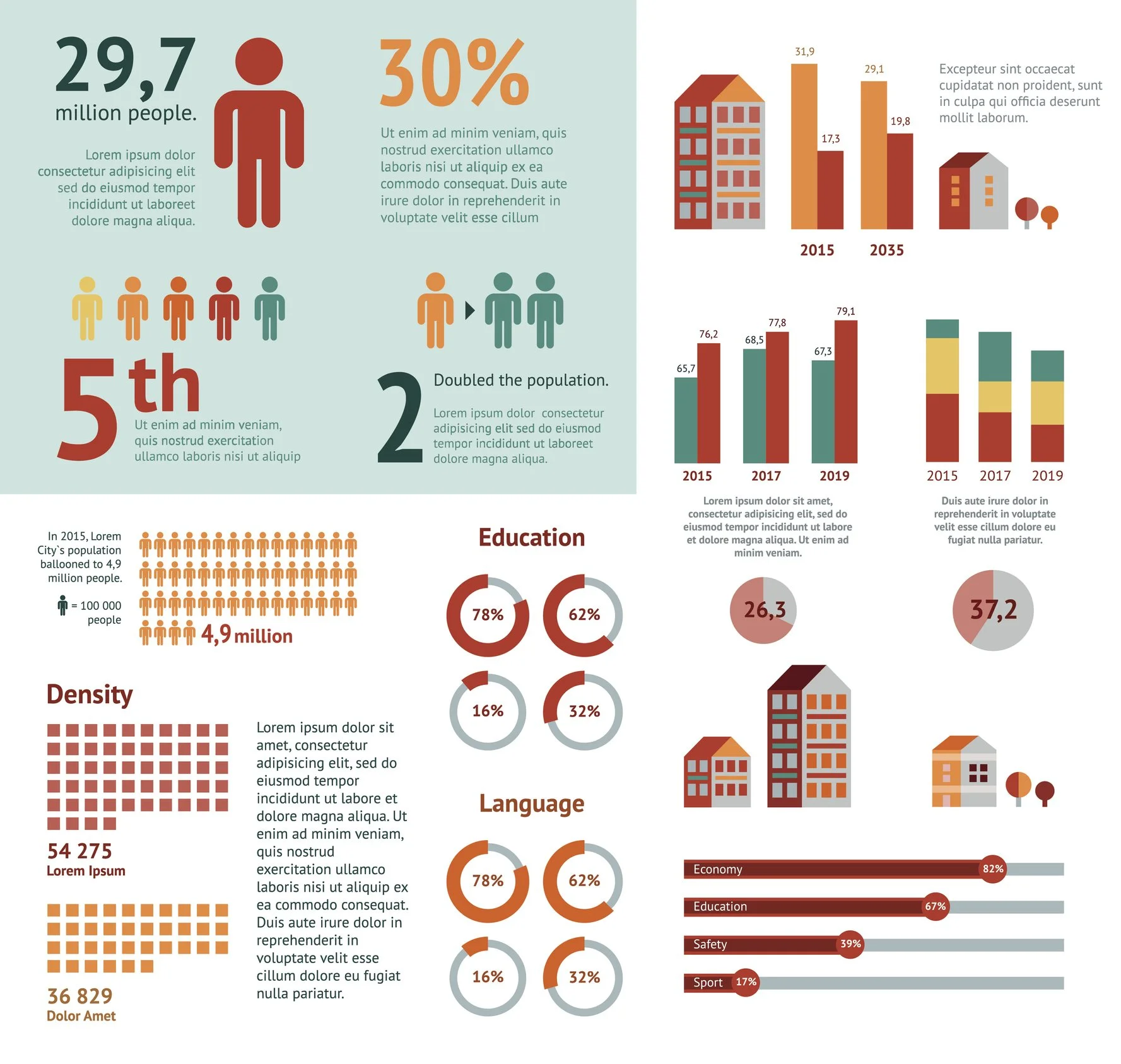
Generic infographic collage from istock by Getty Images.
The Object 2 (and other Objects) Checklist
In reviewing successful AIA Fellowship submissions, a pattern has emerged. For those pursuing Object 2, Practice (Management), the jury isn't just looking for “good work,” running a firm exceptionally well, or any of those standards of practice we strive for. The jury seeks a clear “ripple effect” of leadership, innovation, and sharing. I like to call it your “resonance.” How has your approach or specific methods changed the way others—a measurable group of others—practice and/or how have they served the public?
To transform your case from one that illustrates an exceptional architect to a Fellows-worthy member of the AIA, your submission should include at least four or five of the following.
1. The Impact Infographic (valid for Objects 3-6 as well)
Immediately following the 2.0 CV, compose a robust, by-the-numbers high-impact infographic page that translates Section 2’s detail of Significant Work into data. Potential metrics to articulate are:
Scale: Total population or number of communities impacted.
Volume: Total number of purpose-driven projects completed.
Service: Cumulative hours of community leadership or pro-bono service.
Validation: Total number of project awards and recognitions.
2. Award-Winning Proof of Concept
In Object 2, Practice, typically projects—built or planning work—provide evidence your methods work.
Representation: The jury isn’t looking for just beautiful buildings, though jury demands for well-articulated diagrams and good photography have only increased. Remember, you are representing yourself as one of the top 3% of AIA’s member architects; present yourself and your work as such.
Reinforcement: Every project featured should explicitly link back to the management philosophy, practice method, or community/user group impact you are claiming as your legacy.
Validation: List abbreviated award and publication lists under projects in 2.1 Significant Work.
3. Mentoring the Next Generation
A legacy isn't a legacy if it dies with you. The jury looks for active involvement in academia and mentoring.
How: How are you spreading the ideas behind your practice model?
Where: Show the conferences, academic venues, and/or professional education forums where you have shared your approach with young people, students and/or emerging professionals.
Who: Gather numbers on how many people you’ve spoken with and/or mentored and how far they have progressed since your influence.
Example: One client created a “family tree” of all the emerging designers she mentored in her practice, showing those who formed their own firms and those who became part of new design teams. Others have included maps illustrating where students they worked with came from and went after graduation. These examples show reach, influence, and resonance with clarity.
4. Extensive Publication (Amplify “By the Nominee”)
It’s one thing to be written about; it’s another to be the writer. For Object 2—and other Objects—the jury looks for content both about you and your work and by you. Today’s media world is fluid, with a range of publication opportunities that transcend traditional journals and newspapers. This includes:
Books, articles and Whitepapers.
Industry-leading videos or podcasts. These also can be open-access resources on your website.
Articles in professional journals and digital venues.
Case studies published open-source on your website.
Check my previous post to explore publication opportunities for your thought leadership.
Note: A self-published monograph on your work is only valuable if it is a) instructional and b) shared and used broadly. Passing a book of work on to your clients doesn’t show an effort to influence the practice of architecture beyond your firm’s footprint.
5. The Podium: Broad Speaking Engagements
Are you a recognized voice? Maybe not, but demonstrating a consistent history of speaking beyond the walls of your firm is invaluable to making a clear case from resonance:
Academic venues (guest lectures, studios).
Professional conferences (AIA, NCARB, ULI, or industry-specific summits).
Community forums (public advocacy and leadership).
6. The Data of Stewardship (Sustainability & Resiliency)
The AIA Framework for Design Excellence is now a professional standard. In seeking the “F,” a commitment to sustainable and resilient work and practices isn't enough.
Document your efforts to preserve the environment, reduce resource consumption, and ensure architecture’s long-term durability with hard data.
Metrics: Carbon capture numbers, energy reduction percentages (EUI), recycled content, energy saved, and so on.
Alignment: The AIA Framework for Design Excellence is all encompassing; community benefit, change, health and wellness, and economics all fall within the Framework. Consider its criteria as more than requirements for a project—consider how they live within your practice. (If you haven't watched the AIA's introductory videos on the Framework, it’s an essential starting point for articulating your thinking as a practice leader.)
Is Your Narrative Ready?
Object 2 is about more than just being a firm leader. It’s about being a pioneer. If you can’t point to the numbers, the publications, and the people you’ve influenced, it’s time to bridge those gaps before you hit "submit."
About this Series This analysis is part of an ongoing effort to bring transparency and data-driven insight to the AIA Fellowship process beyond the extensive materials provided at aia.org.
Want to dive deeper? In my book, Architect + Action = Result, I give up the secrets I’ve gathered over 20 years of helping nominees. If you want a clear, actionable strategy for framing your impact—without the jargon or the fallacies—this is for you.